DDoS TestingFree Exposure Check
Adaptive, multi-vector DDoS testing that changes as your defenses respond.
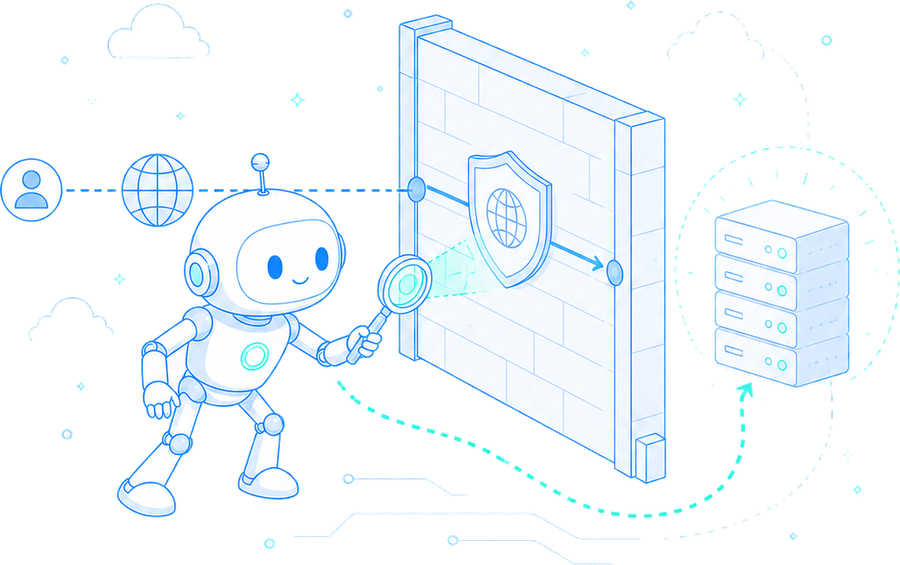
Free. No signup. Public records only — we never contact the site, so nothing appears in its logs.
DDoS testing, defined plainly
DDoS testing (also called DDoS simulation) is a controlled, adversarial evaluation of how your infrastructure holds up when it is flooded with malicious traffic. A test sends realistic attack patterns at your defenses, on purpose and under control, so you learn where they bend and where they break before a real attacker does.
Either way, the test reproduces the traffic a real botnet would generate, at controlled scale, against the systems meant to absorb it. BlackNeuron is a DDoS testing company, and our methodology is Adaptive DDoS Testing.
DDoS simulation: a real attack, under control
A DDoS simulation is a DDoS test run as a controlled reproduction of a real distributed attack. It puts the same traffic a real botnet would generate, at the scale it would generate it, against the same defenses meant to absorb it, only authorized, scoped, and observed, so nothing is left to chance and nothing spills past the boundary you set.

A simulation is only as useful as how faithfully it mirrors a real adversary. A single-vector script the defense has already learned to expect proves almost nothing. A credible DDoS simulation combines vectors the way real attacks do, escalates the moment a control engages, and shifts as the defense responds. That is why ours are adaptive and multi-vector, not a fixed replay a detector can memorize.
Run it against AWS, Azure, GCP, Cloudflare, any other cloud, or on-premise (On-Prem), and a DDoS simulation surfaces the same three answers every time: which control fails first, how long mitigation actually takes, and where a determined attacker would still get through. Those answers are what turn a test into professional resilience engineering, reinforcing the exact weak points the simulation exposed so that even the most capable adversaries, up to and including state-sponsored campaigns, struggle to turn a strike against your infrastructure into a serious outage.
What a real test actually validates
The question is never “did the site stay up.” It is whether each defensive control does its specific job under pressure.

Detection and time-to-mitigation
How long from attack onset until the defense actually engages. That gap is where outages live.

Mitigation cutover
When mitigation kicks in, does failover stay clean, or does it drop legitimate users along with the attack?
Autoscaling behavior
Does the platform absorb the load, or scale into a runaway bill and a tip-over failure?

Origin exposure
Can an attacker find and hit your origin directly, bypassing the CDN entirely?

Layer-7 resilience
Application-layer floods that look like real users and slip past volumetric defenses.

Multi-vector pressure
Real adversaries combine vectors at once. Sequential, one-at-a-time testing misses what simultaneous pressure reveals.

Adaptive by design
Most testing replays a fixed script. Real attackers do not. Adaptive DDoS Testing adapts in real time to how your defenses respond, escalating and shifting vectors the way a human adversary would. AI drives the multi-vector pressure while engineers stay in control of the test.
That is the difference between confirming a checkbox and finding the seam that actually gives way.

Wherever your infrastructure lives
Every environment has its own controls and its own authorization rules. The methodology maps to each.


Deep dives
The methodology in detail, written engineer to engineer.


Managed or self-run
Run a test with us managing it end to end, or self-run with our tooling and guidance. You choose how hands-on you want to be.
One project, no lock-in
A single, scoped engagement, not an annual contract. You get the test, the findings, and a remediation path, without a long-term commitment.
Production-safe and authorized
Testing production safely is a methodology problem, not a “hit it harder” problem. Every cloud requires authorization for simulated DDoS, and we run within each provider’s process.
Three levels of test, and the difference matters
Most of the market sells one thing and calls it DDoS testing. These are three different exercises that answer three different questions, and the right one depends on what you have to prove.
Vector by vector
One attack class at a time, against one control.
The right answer when you need to isolate a single defense and see it clearly, or when an auditor wants a specific control evidenced on its own. It is the least like a real attack and the easiest to read, which is exactly why it comes first.
Simultaneous multi-vector
Several attack classes at once, the way real campaigns arrive.
Real adversaries do not queue politely. Running volumetric, protocol and application-layer pressure together is where defenses that each passed on their own start to interfere with one another, and where shared capacity turns out to be shared in ways nobody documented.
Adaptive
The test changes as your defense responds. Patent-Pending.
A fixed script is something a detector can learn. An adaptive test shifts vector, rate and source distribution in real time as controls engage, so what it measures is not whether you survived one rehearsed pattern but how your defense behaves against something that is actively trying to get past it.
A straightforward sequential test is the right answer for some requirements, and we will tell you when it is. What adaptive testing means, in engineering terms.
What a test exercises
Not every engagement runs every vector. Scope decides that. This is the surface a complete programme covers, and each one links to what it actually does.
Network and transport
Reflection and amplification
Application layer
How an engagement runs
The traffic is the short part. Everything that makes it safe, and everything that makes it count afterwards, happens either side of it.
Scope and authorization
What is in the blast radius, who signs it off, which systems are explicitly out. It also settles a question most people meet late: several major cloud providers forbid customers generating their own DDoS traffic against workloads they host, and require the exercise to run through an approved partner. Getting that wrong turns a test into a terms-of-service problem. Nothing starts until all of it is written down and agreed.
Rules of engagement and abort gates
The thresholds that stop the test, who can call it, and how fast. Abort gates are what make an aggressive test safe to run against production.
Execution and observation
The test runs while both sides watch the same telemetry. What matters is not the peak number but the moment each control engages, and what it costs when it does.
Evidence and remediation
A report a board or an auditor accepts, tied to the controls that were exercised, plus the specific fixes. Then a retest, because a finding without a retest is an opinion.
The document that governs all of it is the test plan. Scope, rules of engagement, success criteria and abort gates. Where the evidence has to satisfy a regulator, start with DORA or, for UK financial institutions, CBEST.
DDoS testing, penetration testing and load testing
Three exercises that get confused with one another in budget meetings. They exercise different controls and produce different evidence, and none of them substitutes for another.
| DDoS testing | Penetration testing | Load testing | |
|---|---|---|---|
| What it asks | Does the service stay available under attack? | Can someone get in? | Is it fast enough at expected volume? |
| Traffic used | Real attack techniques, hostile by design | Targeted exploitation attempts | Simulated legitimate users |
| Controls exercised | CDN, WAF, rate limits, scrubbing, autoscaling | Auth, input handling, access control | Application and database capacity |
| Typical failure found | Mitigation engages too slowly, origin reachable | A path to data or privilege | A slow query under concurrency |
| Evidence produced | Time-to-mitigation, control-by-control results | Findings by severity | Latency and throughput curves |
| Answers DORA and NIS2 resilience testing | Yes | Partly | No |
Every environment we test
What a test can reach, what the provider permits, and what you are allowed to prove all change with the environment. Each of these covers one properly.
Hyperscale clouds
Edge and CDN
Independent providers
Architectures
By attack surface
What it costs
Published market rates run from free configuration scans, through self-service platforms in the hundreds to low thousands per test, up to around 40,000 USD for a full managed engagement covering simulation, remediation support and a retest. What moves a quote is scale, how many vectors are in scope, and how much engineering sits alongside the traffic.
Common questions
What is DDoS testing?
DDoS testing is a controlled, authorized exercise that directs realistic distributed attack traffic at your own infrastructure to measure how its defenses behave. It establishes which control fails first, how long mitigation actually takes to engage, and where an attacker would still get through.
What is the difference between DDoS testing and DDoS simulation?
They describe the same exercise. Simulation emphasises that the traffic reproduces what a real botnet would send; testing emphasises that the point is measurement. In practice the terms are used interchangeably across the industry.
What should you ask a DDoS testing provider before engaging them?
Four things. Whether they run vectors simultaneously or only one at a time, because a sequential script proves far less than a combined one. What the abort gates are and who can pull them. Whether a retest after remediation is included or billed again. And whether the engagement is a fixed subscription or a scoped project, since DDoS testing services are sold both ways and the annual commitments some vendors require can price out an organisation whose real need is a handful of well-scoped tests a year.
How do DDoS testing services differ from running a test yourself?
Mostly in what you are permitted to do and what you can prove afterwards. Several major cloud providers forbid customers generating their own DDoS traffic against workloads they host and require an approved partner instead. Beyond permission, DDoS testing companies bring source distribution you cannot reproduce from a handful of machines, and produce evidence in a form an auditor accepts.
Is DDoS testing safe to run against production?
Yes, when it is authorized, scoped, actively monitored and built with abort gates that stop it automatically at agreed thresholds. Many organisations test production deliberately, because a staging environment rarely shares the same capacity, routing or provider limits.
How long does a DDoS test take?
The traffic itself is usually hours rather than days. The engagement around it runs longer: scoping and authorization before, and evidence and retesting after. A single-vector validation can complete in a day; a multi-environment programme runs over weeks.
How much does DDoS testing cost?
Published market rates run from free configuration scans, through self-service platforms in the hundreds to low thousands, up to around 40,000 USD for a full managed engagement including simulation, remediation support and a retest. The drivers are scale, number of vectors and how much engineering support is included.
Do I need permission from my cloud provider?
Usually yes, and the rules differ by provider. Several major clouds prohibit customers from running their own DDoS simulations and require the test to go through an approved partner. Confirming the provider position is part of scoping, before anything is scheduled.
What does DDoS testing actually measure?
Time from attack onset to mitigation engaging, whether cutover drops legitimate users, how autoscaling behaves and what it costs, whether the origin can be reached directly, and how application-layer controls hold when the traffic looks like real users.
How is DDoS testing different from penetration testing?
A penetration test asks whether someone can get in. A DDoS test asks whether the service stays available when someone tries to take it down. They exercise different controls, produce different evidence, and neither substitutes for the other.